UK: 03330 156 651 | IE: 01263 5299
-
UK: 03330 156 651
-
IE: 01263 5299



Hybrid work has moved from “policy” to “infrastructure”. Across Scotland, hybrid work is no longer an experiment. It’s the operating model, but SME’s keep overlooking the importance of business phone systems in Scotland. Whether you’re a professional services firm in Glasgow, a tech team in Edinburgh, or a growing SME with staff spread across the Central Belt and beyond.

Most businesses have already upgraded the obvious hybrid essentials:
- Reliable business-grade internet
- Tools for chat, meetings, and file sharing
- Support that actually answers
- Spaces that flex up or down with headcount
- Predictable monthly costs
But there’s one layer that’s often left behind until it starts causing real friction: your phones.
If your team is split across home, office, customer sites, and coworking days, the “old” approach—desk phones tied to one building, clunky transfers, limited visibility on missed calls – creates problems everywhere. Customers don’t care where your team is working from. They expect calls to be answered quickly, routed correctly, and handled professionally.
That’s why business phone systems in Scotland are no longer a nice-to-have for Scottish SMEs. They’re the core operational infrastructure.
Why hybrid work exposes weaknesses in legacy phone setups
Hybrid working turns small issues into recurring problems:
Calls don’t reach the right person
Someone is remote, someone is in a meeting room, someone is on a site visit. Without intelligent routing, calls get missed, bounce between people, or land in voicemail limbo.
“Just call my mobile” becomes the default
This feels convenient at first – until it isn’t. Customers see inconsistent caller IDs, staff use personal numbers, and the business loses control and visibility. It also creates risk when key relationships live on one person’s phone instead of inside the company setup.
Transfers and coverage become messy
Legacy systems weren’t designed for distributed teams. Voicemail isn’t centralised, coverage becomes ad-hoc, and “who’s on the phones?” becomes a daily operational question.
You can’t measure what’s happening
Without efficient reporting tools, you don’t know:
- How many calls were missed
- When peak volumes hit
- Where customers drop off
- Whether calls are being answered fast enough
For many SMEs, that’s not just inefficient – it’s lost revenue.
Business VoIP Scotland: what it is and why SMEs are switching
When people talk about modern phone setups, they usually mean VoIP -calls delivered over an internet connection rather than traditional analogue lines. For hybrid teams, business VoIP Scotland works well because it matches how work happens now: distributed, mobile, and cloud-first.
Instead of your phone system being tied to an office PBX, the core system sits in the cloud. That enables features that are hard (or expensive) to do well with older setups:
- Ring groups for sales/support/accounts
- Auto-attendants (“Press 1 for…”) that route correctly
- Call queues and overflow during busy periods
- Voicemail-to-email so messages don’t get lost
- Apps for laptops and mobiles that still present the business number
This isn’t about being “more technical”. It’s about making sure customers can reach you, regardless of where your team is sitting today.
Cloud phone system Scotland: designed for teams that aren’t always in one place
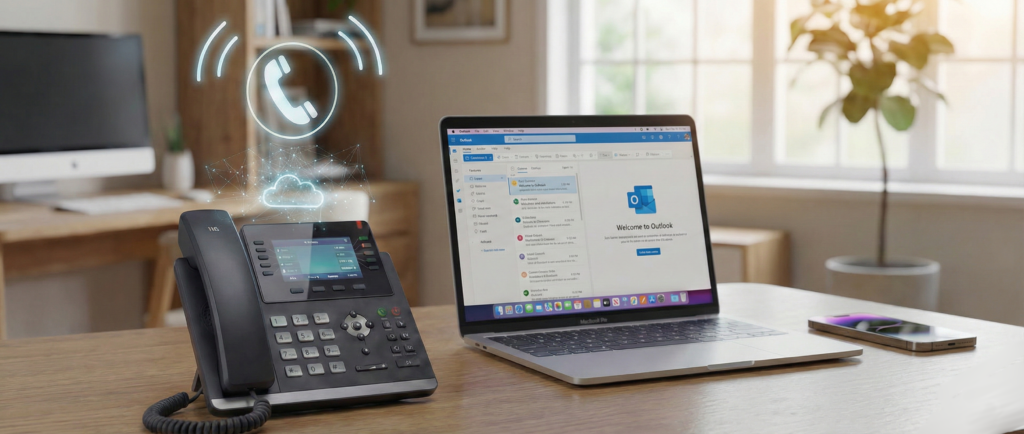
A cloud phone system in Scotland gives your staff flexibility without breaking the customer experience. Your team can take calls through:
- desk handsets (in the office)
- a desktop softphone (remote days)
- a mobile app (site visits, travel, out-of-office cover)
The key advantage is consistency. Even when staff move around, you keep:
- One business identity
- One set of call flows
- One reporting view
- One professional caller ID
For Scottish SMEs with clients across regions or staff commuting between Glasgow and Edinburgh—this is often the difference between “hybrid works” and “hybrid is chaos.” Resilience isn’t theoretical – Ofcom has recently opened investigations into major network outages that disrupted calling, reinforcing why continuity planning matters.
Hosted phone system Scotland: what “hosted” means in practice
The term “hosted” is simple: the system is managed and maintained by your provider, rather than running on equipment you own onsite. A hosted phone system Scotland typically means:
- Updates and maintenance are handled centrally
- Scaling users up/down is quicker
- remote working is supported by design
- You avoid the PBX in a cupboard” problem
For SMEs, hosted systems reduce complexity because your phone setup becomes a managed service rather than an in-house project.
SME phone system Scotland: what to look for before you choose
The right SME phone system for Scotland should be chosen around workflows, not feature lists. Start with practical questions:
1) What happens when a customer calls your main number?
- Who answers first?
- What if that person is busy?
- Where should calls overflow to?
2) Do you need sales/support separation?
If you have multiple functions, you’ll want ring groups, routing rules, and reporting split by department.
3) Do you need visibility to improve performance?
Look for reporting that shows missed calls, answer times, and peak hours. If phone enquiries drive revenue, this matters.
4) Do you need integrations?
Some teams benefit from CRM integration, click-to-call, or shared call notes—especially customer-facing roles.
5) How important is business continuity?
Ask what happens if broadband drops. Many systems can reroute calls automatically—if configured correctly.
Scotland phone services: what to compare beyond price
Many providers sell “phone services” as if it’s just minutes and handsets. In reality, Scotland’s phone services should be assessed on four pillars:
Call quality and reliability
Voice is real-time traffic. If your broadband, router, or Wi-Fi isn’t designed for voice, quality suffers—especially in meeting rooms.
Support and accountability
When something goes wrong, do you get help quickly—or do you end up stuck between a broadband supplier and a phone supplier?
Number porting and onboarding
A smooth migration keeps your number and minimises downtime. A good provider runs switching as a managed process.
Security and control
Fraud happens. A strong setup includes sensible permissions, call restrictions, and monitoring. It’s also worth aligning your phone admin and access controls with broader small-business security good practice.
Choosing a Scottish VoIP provider: what “good” looks like
When evaluating a Scottish VoIP provider, look for evidence they can run the whole service properly:
- a clear onboarding and migration plan
- support that understands voice and connectivity
- call flow design based on how your business operates
- reporting that helps you manage performance
- resilience options (rerouting, backup connectivity)
The biggest practical win for hybrid SMEs is often one accountable partner instead of stitching together multiple suppliers.
FAQs
Are business phone systems in Scotland still important if we use Teams/Zoom?
Yes—because customers still call. A phone system provides a stable inbound channel, call routing, business continuity, and reporting that meeting tools don’t replace.
Is VoIP reliable in Scotland?
It can be – when broadband and Wi-Fi are designed for voice and your provider supports you properly. Most “VoIP problems” are actually network problems.
What’s the difference between hosted and cloud phone systems?
They’re often used interchangeably. “Hosted” describes who manages it (the provider). “Cloud” describes where it runs (online, not onsite).
Where Yellowcom fits for hybrid teams
For Scottish SMEs, communications work best when they’re aligned with the rest of the hybrid stack:
- business-grade connectivity that can support voice and cloud tools
- calling that follows staff across office/home/mobile
- support that resolves issues quickly end-to-end
- workspace access when teams need to collaborate or meet clients
That bundled approach is where Yellowcom adds value: fewer handoffs, faster troubleshooting, and a setup built for real hybrid working – not a legacy phone system stretched beyond its limits.