UK: 03330 156 651 | IE: 01263 5299
-
UK: 03330 156 651
-
IE: 01263 5299



Every business owner knows the frustration of staring at a website dashboard that shows plenty of visitors but a completely silent inbox. You’ve invested time, effort, and money into launching a clean, modern small business website, yet the phone isn’t ringing, and the contact forms remain untouched.
When digital traffic doesn’t convert into paying customers, it’s rarely because your services aren’t good enough. Instead, it is usually because your website is built upside down.
Most business websites focus heavily on what they sell rather than who they solve problems for. They treat every visitor exactly the same, offering a generic menu of services that forces the prospect to do the hard work of figuring out if your company truly understands their world.
In today’s highly competitive digital landscape, generic messaging is a fast track to invisibility. To cut through the noise, build immediate trust, and drastically increase your qualified enquiries, you need to leverage the power of Sector Pages. This guide will provide the ultimate roadmap for transforming your website from a passive digital brochure into an active lead-generation engine.
What are Sector Pages? (And Why Your Website Needs Them)
A sector page, sometimes referred to as an industry landing page, is a dedicated area of your website designed entirely around the needs, language, compliance demands, and operational challenges of a single, specific target market.
Instead of forcing a legal firm, a construction company, and a medical clinic to read the exact same generic “About Our IT Protocols” page, you build a distinct pathway for each of them.
The Shift in Modern Search Behaviour
The way people search for business solutions has changed dramatically. Years ago, a buyer might have typed a broad phrase like “telecoms provider” or “IT support” into a search engine. Today, search behaviour is highly contextual, specialized, and conversational. Buyers, and the modern AI search algorithms that serve them answers, look for highly targeted, zero-friction solutions.
Consider these two different search scenarios:
- Scenario A: A dental practice manager searches for “cloud-based VoIP telephony.” They are met with millions of results displaying technical jargon, data bandwidth tables, and abstract feature lists.
- Scenario B : The same practice manager searches for “compliant patient call routing systems for dental clinics.”
If your website only features a generic product page, you are competing with global tech giants for Scenario A. But if you have a dedicated page designed specifically for healthcare providers, you instantly win Scenario B.
The Psychological Impact of Industry Specificity
When a prospect lands on a webpage tailored to their exact industry, their psychological friction drops to near zero. Trust is built instantly when they see their sector’s specific vocabulary, their exact regulatory frameworks (such as GDPR, SRA, or CQC compliance), and their day-to-day operational pain points laid out clearly. It signals that you aren’t just a generic vendor trying to make a sale; you are an industry specialist who speaks their language.
To see how this strategy looks in practice and how clear, targeted navigation can guide a user seamlessly to the right solution, take a look at theYellowcom Sectors Hub. Notice how each industry pathway immediately reframes our core technologies around distinct operational realities.
The Commercial & SEO Power of Niche Targeting
Many small business owners hesitate to build sector-specific pages because they worry about alienating potential customers outside of those niches. They reason that keeping the message as broad as possible will cast the widest net.
In reality, casting a wide net on the internet just means you catch nothing but digital noise. Niche targeting isn’t about limiting your business; it’s about dominating specific pockets of the market where your conversion rates will be exponentially higher.
High-Volume vs. High-Intent Keywords
When you seek help with website optimization and SEO, amateurs will often point you toward high-volume keywords. They want to show you big numbers. However, high-volume keywords are incredibly expensive to target, fiercely competitive, and plagued by low conversion rates.
Sector pages utilize low-volume, high-intent keywords. Fewer people search for these terms, but those who do are highly qualified, motivated buyers with budgets ready to spend.
Let’s look at the commercial reality of this structural shift:
| Metric | Generic “Services” Page | Targeted “Sector” Page |
| Search Keywords | “IT Support UK” / “Business Telecoms” | “IT Support for Legal Firms” / “Telecoms for Construction” |
| Competition Level | Extreme (Fasting national brands & directories) | Low to Moderate (Highly winnable for local businesses) |
| Buyer Intent | Informational, early-stage browsing | Transactional, actively looking for a specialized vendor |
| Average Conversion Rate | Typically less than 1% to 2% | Often ranges from 5% to over 10% |
| Customer Acquisition Cost | High (Requires massive ad spend or years of broad SEO) | Low (Highly targeted traffic converts quickly) |
Maximising Paid Advertising ROI
If you run paid advertising campaigns (such as Google Ads or LinkedIn Ads), sector pages are your secret weapon. If you pay for an ad targeting construction companies and send that traffic to your homepage or a generic service page, most visitors will bounce immediately because the content doesn’t feel relevant to them. Google will notice this, lower your quality score, and charge you more per click.
By directing that ad traffic to a dedicated construction sector page, your relevance score skyrockets. The ad copy matches the landing page copy perfectly. This lowers your cost-per-click (CPC) and dramatically increases the return on your marketing investment.
Step-by-Step Blueprint for a Perfect Sector Page
Creating an effective sector page involves more than just copying your homepage text and swapping out a few words. To turn visitors into inbound leads, every element of the page must be intentionally engineered.
Here is the structural anatomy of a high-converting sector page:
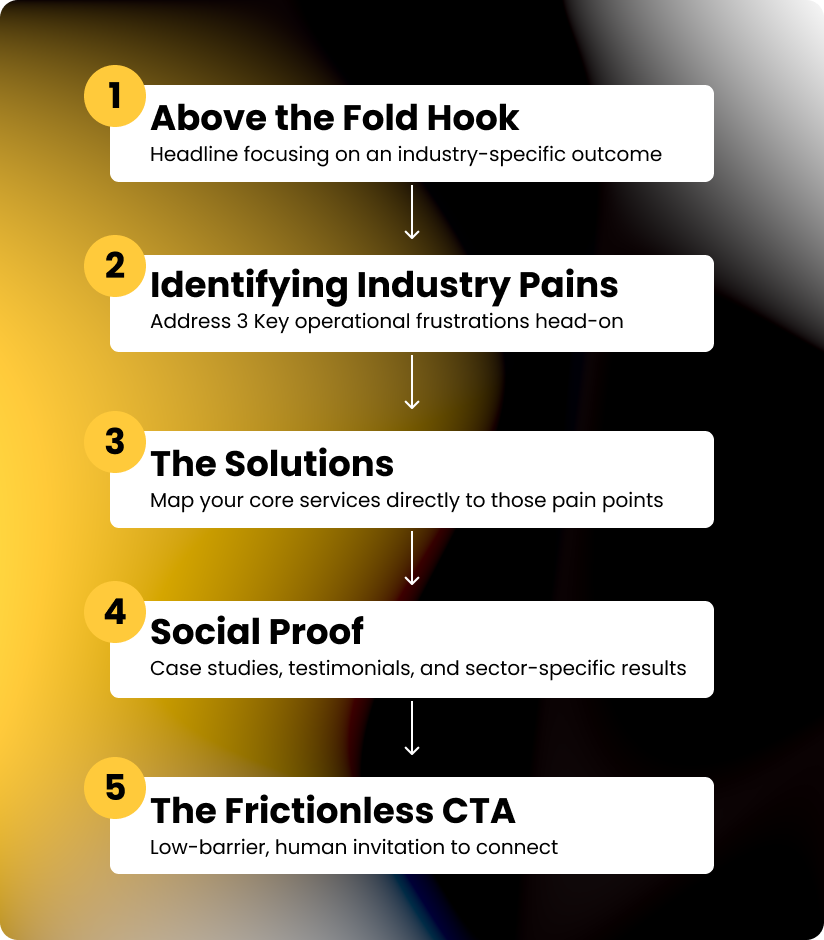
1. The Above-the-Fold Hook
The “above-the-fold” area is everything a visitor sees before they scroll down. This is where you either win or lose their attention within three seconds.
- What to avoid: Vague, self-centric statements like, “We provide industry-leading telecom services to the care sector.”
- What to do instead: Use bold, outcome-driven, client-centric language. For example: “Never Miss a Care Request: Ultra-Reliable, Compliant Communications Built for Modern Care Homes.”
2. Identifying Industry Pain Points
Before you explain what you do, prove that you understand their daily struggles. Dedicate a prominent section of the page to the top three structural, financial, or operational challenges that specific industry faces.
If you are writing a page for logistics companies, talk about vehicle tracking dead zones, supply chain data latency, and missed delivery windows due to poor communication. When the reader sees their daily frustrations perfectly articulated, their internal monologue changes from “Is this company trying to sell me something?” to “Wow, these people actually understand my job.”
3. The Solution Matrix
Once the pain points are established, introduce your specific services—not as a dry list of features, but as direct answers to those problems.
If a law firm’s core frustration is the catastrophic risk of a data breach, your solution isn’t just “Cybersecurity Services.” Your solution is “Airtight, SRA-aligned data encryption environments that guarantee absolute client confidentiality.”
To map out how your overarching services connect to specific operational solutions, use a clear structural hierarchy on your site. You can analyze how we align diverse technical offerings by reviewing ourYellowcom Services Directory.
4. Industry-Specific Social Proof
Generic testimonials like “Great service, highly recommend!” do very little to move the needle on a sector page. Instead, feature detailed quotes, logos, or brief mini-case studies from clients who operate within that exact industry.
A prospective manufacturing client wants to see how you helped another factory reduce production line downtime, streamline warehouse communications, or secure their operational technology.
5. The Frictionless Call to Action (CTA)
End the page with a highly visible, low-barrier call to action. Avoid robotic, demanding buttons that just say “Submit” or “Buy Now.” Keep it human, conversational, and highly relevant to the sector. Use phrases like “Speak with our Legal Technology Specialist” or “Request an On-Site Telecom Audit for Your Warehouse.”

Sector-Specific Tailoring: Real Examples for UK & Ireland Businesses
To give you a head start on expanding your small business website, let’s look at three content blueprints for major business sectors across the UK and Ireland. You can adapt these structures for your own landing pages immediately.
1. The Healthcare & Dental Sector
- The Core Focus: Compliance, ironclad security, and patient-first reliability.
- Key Pain Points to Address: Dropped patient calls during peak morning rushes, complex CQC or HSE data management regulations, and the fear of ransomware attacks halting access to patient records.
- The Language to Use: Prioritise words like secure, encrypted, compliant, uninterrupted, seamless integration, and patient confidentiality.
- Service Mapping: Frame cloud-based telephony as a tool that automatically queues patient calls and prevents busy signals, and position cloud backup solutions as essential compliance safeguards for electronic health records.
2. The Professional Services & Legal Sector
- The Core Focus: Data integrity, precise time-tracking, and absolute confidentiality.
- Key Pain Points to Address: Billable hours lost to clunky, lagging remote-work software; the strict data security mandates set by the Solicitors Regulation Authority (SRA) or the Law Society; and the risk of disaster wiping out case histories.
- The Language to Use: Focus on terms like risk mitigation, business continuity, maximum uptime, ironclad security, certified compliance, and audit trails.
- Service Mapping: Position your IT infrastructure services around disaster recovery protocols (ensuring a firm can access files within minutes of an emergency) and secure remote networks that allow partners to access sensitive data safely from a courtroom or home office.
3. The Construction, Logistics, & Transport Sector
- The Core Focus: Physical durability, rapid site deployment, and cross-team mobility.
- Key Pain Points to Address: Delays caused by slow internet provisioning at new construction sites, rugged environments destroying standard communication hardware, and dangerous communication gaps between field staff and head office.
- The Language to Use: Lean heavily on phrases like rapid deployment, ruggedized hardware, site-to-site connectivity, real-time tracking, scalable, and weatherproof.
- Service Mapping: Highlight temporary business broadband networks that can be deployed to a site cabin in days rather than months, alongside mobile device management (MDM) setups that keep field teams safely connected via rugged, drop-tested smartphones and tablets.
Free Tools for Small Businesses to Optimise Their Site
Building high-converting sector pages doesn’t require a massive research budget or an expensive team of digital analysts. As a business owner, you can access powerful, industry-standard tools for free to diagnose your website, discover exactly what your audience is searching for, and optimize your overall user experience.
1. For Tracking Real Search Queries: Google Search Console
Before you write a single word of new content, you need to understand how people are currently interacting with your brand online. Google Search Console is an essential, free tool that acts as a window into your search performance.
It reveals the exact phrases, questions, and niche queries real users type into search engines to find your website. If you notice that local companies are already finding you via highly specific terms, you have found the perfect baseline data to build your very first sector page. Search Console also alerts you instantly if Google encounters indexing bugs or technical errors that prevent your pages from showing up in search results.
2. For Uncovering Customer Questions: AnswerThePublic
If you are struggling to figure out what questions your industry targets are asking online, AnswerThePublic is a fantastic resource. By typing in a simple, broad phrase related to your industry—such as “IT support law firm” or “broadband for construction”—the tool generates a visual map of the exact questions, prepositions, and comparisons real people are searching for.
This gives you a constant stream of highly relevant headings, FAQ content, and blog ideas tailored perfectly to the distinct concerns of your target sectors.
3. For Testing Speed and User Experience: Google PageSpeed Insights
You can build the most beautifully written sector page in the world, but if it takes too long to load, your prospects will click away before reading a single word. Mobile responsiveness and speed are critical ranking factors for search engines and essential for conversion.
Google PageSpeed Insights provides a comprehensive, objective analysis of how your desktop and mobile website performs. Simply paste your URL into the tool to receive a clear, color-coded score alongside simple, actionable recommendations on how to compress heavy images, clean up slow scripts, and ensure your site loads fast on mobile networks.
Bridging the Gap: When to Call in the Experts
Planning out a content strategy, organizing your navigation menus, and brainstorming ways to solve your clients’ pain points are highly rewarding steps toward growing your business. However, the technical execution of these ideas can quickly turn into a major bottleneck for a busy business owner.
Mapping out complex page hierarchies, managing technical SEO redirects, securing online contact forms against malicious spam, and maintaining fast, stable backend loading speeds require specialized technical knowledge and hours of meticulous work. Every hour you spend trying to fix a broken layout block or troubleshooting a website plugin is an hour taken away from serving your clients and managing your operations.
The Technology Infrastructure Connection
There is another vital layer to consider: your digital presence is deeply connected to your underlying business communication infrastructure.
A highly optimized sector page will successfully drive an influx of fresh inbound leads to your business. But what happens next?
- If a prospect clicks the phone number on your new legal sector page, your internal cloud telephony (VoIP) routing must be configured perfectly to send that call straight to the correct specialist, whether they are working from home or at their desk.
- If a new medical client submits an urgent enquiry form, your workplace broadband, cloud hosting, and data backup networks must be reliable and resilient enough to handle that data securely without lagging or dropping connectivity.
A great website acts as the front door to your business, but it requires a solid infrastructure behind it to turn that initial digital interest into long-term commercial success.
If you want practical, hands-on help with your website development, design architecture, or content layout, our digital specialists can manage the entire technical process for you. We bridge the gap between frontend digital marketing and backend technological reliability. Explore our full suite of digital solutions at the Yellowcom Website Development & Digital Services page.
Conclusion & Next Steps
Moving away from a vague, one-size-fits-all online presence is the single most effective change you can make to jumpstart your inbound lead generation. By building targeted sector pages, you stop competing on generic price points and start winning clients based on specialized value, deep operational understanding, and authentic trust.
Start small. Identify your top two or three most profitable industries, use the free tools outlined in this guide to research their core questions, and build dedicated pathways that make those specific audiences feel completely understood.
Don’t leave your business growth, online visibility, or communications setup to chance. If you are ready to modernize your digital presence, protect your company data, and build a reliable, seamless communication infrastructure that handles your growth flawlessly, we are here to support you every step of the way.
Reach out to our local team today via the Yellowcom Quick Enquiry Form to book a straightforward, plain-talking assessment of your business technology needs.